

Draftbit is an innovative and user-friendly visual app creator that has been gaining a lot of attention. With its drag-and-drop interface and pre-built components, solution allows users to create professional and functional solutions without any coding knowledge. In this review, we will take a closer look at the features and capabilities and share our opinions on its overall performance.
Whether you’re a beginner looking to enter field or a seasoned developer in need of a faster and more efficient way, it may just be the solution you’ve been searching for. So let’s dive in and explore the world of Draftbit together.
What is Visual App Creator?
Make with ease
A visual app creator is a software tool that simplifies the process of building mobile and web applications through a graphical user interface (GUI), rather than through traditional coding. These platforms empower users by providing a drag-and-drop environment where elements and components can be visually assembled to construct.
It opens the door to development for individuals who may not have programming skills but possess a clear vision for their digital projects. Users can design the layout, define the logic, and set up the interactions within their solution by selecting and configuring various built-in features and components provided by the platform.
This approach significantly reduces the barrier to entry for creation, enabling a broader spectrum of people to bring their ideas to fruition without the need for deep technical expertise or the hiring of a development team. Visual app creators also often include options for customization and integration with external services, enhancing the functionality and versatility of the solutions on their platforms.
Check also other reviews from this software category: Application Builder Software Reviews.
What is Draftbit?
Software overview
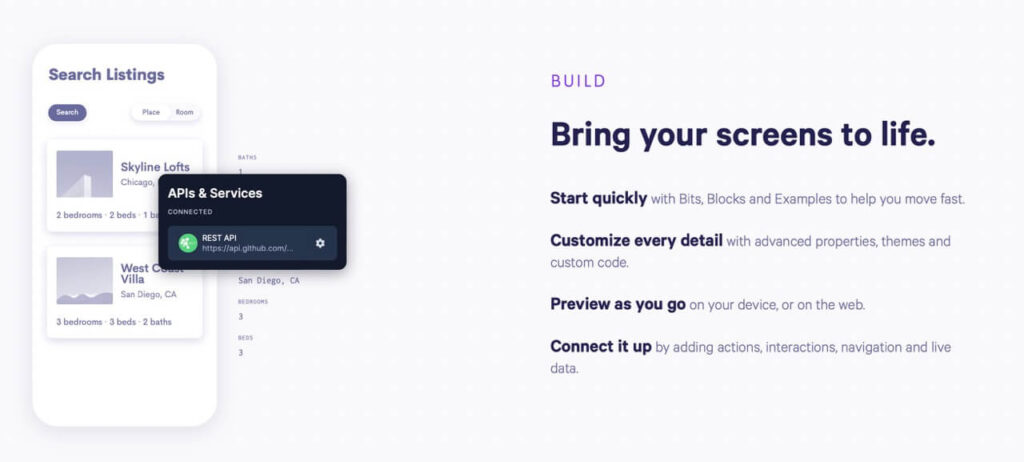
Draftbit emerges as a standout platform in the realm of visual app creation, offering a seamless, no-code solution for creating. It stands out for its comprehensive toolkit that empowers users to drag and drop components effortlessly, crafting custom layouts and incorporating functionalities like buttons, text fields, and more, all without the need for traditional programming. Aimed at democratizing, tool caters to a broad audience, from beginners with no technical background to seasoned designers seeking a quicker way to bring their app ideas to life.

What sets it apart is its focus on not just the ease of app creation but also on the integration capabilities that allow them to function with complexity and sophistication. Users have the opportunity to connect their creations to various data sources, leveraging APIs to enrich the features and user experience. This level of integration opens up possibilities for more dynamic, interactive solutions that can serve a wide array of purposes, from business tools to educational platforms.
Draftbit’s environment is intuitively designed, making navigation and operation within the platform straightforward for users of all skill levels. The balance it strikes between simplicity in design and depth in functionality defines its uniqueness in the visual app creator space. It’s this balance that enables users to transition from concept to a fully functional mobile one with relative ease, streamlining the development process and significantly reducing the time from ideation to deployment.
Draftbit review and opinions
What do we think?
Draftbit has garnered attention for revolutionizing the way, making the process more accessible and less intimidating. Users have shared their experiences, highlighting the platform’s straightforward design interface and the wealth of components available at their fingertips, which allows for the creation of diverse and complex apps across various fields.
The real-time preview feature has been particularly lauded for providing instant feedback, enabling users to adjust their designs on the fly and ensure their app behaves as expected on different devices.
However, it’s not without its critiques. Some feedback touches on the desire for more customization options and deeper integrations with external databases and services, pointing out that while Draftbit offers a robust starting point, there may be moments when developers feel restricted by the platform’s current offerings.
The pricing has also sparked discussions, with opinions divided on whether the cost aligns with the value provided, especially for individuals or small startups working within tight financial constraints.
Despite these concerns, the consensus among users leans towards the positive, with many appreciating the balance Draftbit strikes between simplicity and functionality. The platform is celebrated for empowering a new wave of creators, who might have been sidelined in the traditional app creation ecosystem due to a lack of coding knowledge.
Draftbit pros and cons
Is this solution worth it?
Draftbit shines in the visual app creation market for several reasons. Its intuitive, user-friendly interface stands out, making it effortless for both beginners and experienced users to navigate. The platform’s extensive component library allows creators to build something versatile and dynamic, catering to a broad spectrum of needs and industries.
Another significant advantage is the real-time preview feature, offering immediate visual feedback that helps in refining and perfecting the app’s design and functionality on various devices before deployment.
On the flip side, Draftbit does face certain challenges that may impact its suitability for all users. A recurring point of feedback from the user community is the platform’s limitations in customization and the depth of integrations with external databases and third-party services. This limitation can be a hurdle for developers seeking to build highly specialized one or requiring advanced functionalities that go beyond the provided templates and components.
Additionally, while pricing structure aims to accommodate a range of users, from individuals to enterprises, it may be perceived as prohibitive for those just starting out or operating within a limited budget. The cost of accessing more advanced features and priority support can add up, making it a significant consideration for potential users weighing their options in the market.
Draftbit pricing
Plans and options
Draftbit’s pricing structure is designed to cater to a wide array of users, from individuals just starting out with app creator to large enterprises seeking comprehensive, collaborative tools.
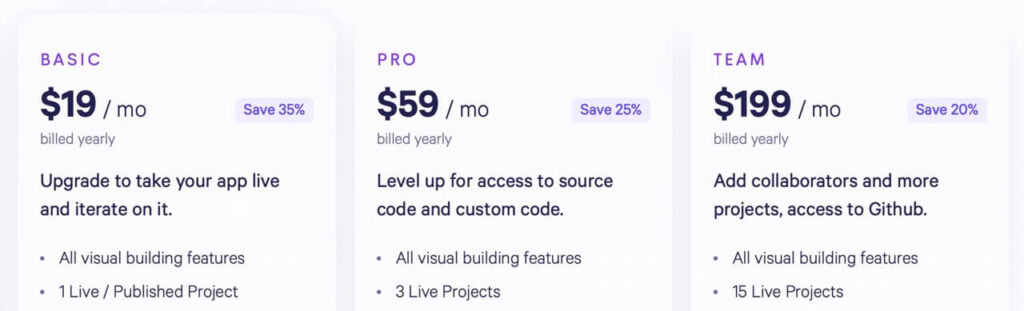
Here’s a breakdown of the available plans: TheBasic plan, at $19 per month when billed annually, is ideal for individuals ready to take their app live. It includes all visual building features, support for one live project with up to 25 screens, unlimited draft projects, and unlimited API endpoints. This plan suits those looking to publish their app to iOS, Android, and the web.
For more advanced needs, the Pro plan is available at $59 per month (also billed annually), offering access to source code and custom code options. It supports three live projects with unlimited screens and maintains the features of the Basic plan but adds the ability to test on iOS and Android simulators, import packages from npm, and export the full source code.
Teams will find the Team plan beneficial at $199 per month, billed annually. It significantly expands the capacity for collaboration with five collaborator seats, 15 live projects, and Github integration, among other Pro features.
There are also 6 additional plans for specific needs and advanced use cases. Each plan is structured to offer flexibility and scalability, ensuring users can select the option that best aligns with their development goals and team size. Importantly, there is also a free one, allowing potential users to explore capabilities before committing financially.
Draftbit alternatives and competitors
What instead of draftbit.com?
While Draftbit offers a compelling suite of features for no-code app creator, it operates within a competitive market bustling with alternatives that cater to a range of needs and preferences. Among its noteworthy competitors are Softr, Glide, Appsmith, and Drafter, each presenting its unique value proposition.
Softr stands out by enabling users to transform Airtable data into engaging soft without coding. It’s an ideal choice for projects that rely heavily on database-driven content, offering a smooth bridge between data management and presentation.
Appsmith distinguishes itself as an open-source platform, attracting developers who wish to build internal tools swiftly. It provides pre-built UI components and allows for the easy connection of databases and APIs, catering to those who might need a more developer-oriented approach to software creation without starting from scratch.
Drafter, though lesser-known, is another competitor, offering tools for rapid prototyping and iteration. Its simplicity and focus on design make it a good choice for those in the initial stages of concept development, who need to visualize and tweak designs before diving into more complex development phases.
Each of these platforms, alongside Draftbit, offers distinct strengths, whether in data integration capabilities, ease of use, community support, or customization options. The choice among this tool and its competitors largely depends on the specific requirements of the project, the preferred data sources, and the degree of customization needed.
For developers and businesses exploring visual app creation tools, evaluating these alternatives against Draftbit could illuminate the best fit for their particular ambitions.
Draftbit free version
Check the trial
Draftbit’s free trial is an inviting option for those new to the platform or visual app creators in general. It’s designed to provide everything a newcomer might need to start creating. The trial offers access to all of visual building features, enabling users to get hands-on experience with the platform’s drag-and-drop interface and component library.
Claim your free account here: Draftbit Main Page.
Participants in the free trial can work on up to three draft projects simultaneously, allowing for exploration and experimentation with different app concepts. Each project can include up to five screens, giving users the freedom to design a variety of interfaces and user experiences.
Additionally, the trial includes access to two API endpoints per project, which is essential for integrating external data and services, thereby adding functionality and depth to the solutions being developed. While the free trial provides a robust set of tools and features for app creation, it’s worth noting that upgrading is necessary to go live and publish.
This structure ensures users can fully explore Draftbit’s capabilities without initial investment, yet also outlines a clear path towards more advanced features and the ability to launch them to the public. This setup makes the free trial an excellent starting point for individuals and small teams eager to delve into app creation with minimal risk.
Final thoughts – opinion
Verdict
Draftbit positions itself prominently in the visual app creator sector, appealing broadly to a spectrum of users from the novices to the more experienced designers seeking efficiency in bringing their visions to digital life. Its standout features—namely the intuitive drag-and-drop interface, comprehensive component selection, and the dynamic real-time preview—enhance the building experience, making it both accessible and efficient. Despite facing some critique regarding customization limitations and integration depths, it’s clear that Draftbit offers substantial value, particularly in democratizing the process.
The platform’s pricing model and the free trial period present a low barrier to entry, encouraging exploration and experimentation without immediate financial commitment. This aspect is especially beneficial for individuals and smaller entities cautious of overheads but keen on exploring possibilities.
Considering the landscape of alternatives, Draftbit holds its ground by offering a balanced mix of ease-of-use, functionality, and support. While other platforms may offer niche advantages—be it in design-centric features or deeper coding capabilities—generalist approach ensures it remains a strong contender for a wide audience.
To those embarking on their app development journey or looking to streamline existing processes without deep technical involvement, Draftbit emerges as a recommendable tool. It strikes a harmonious balance between simplicity and sophistication, making it a worthwhile consideration for anyone looking to convert ideas into functional solutions efficiently.


